
Niche vs. General Communities: How Audience Size Changes the Experience
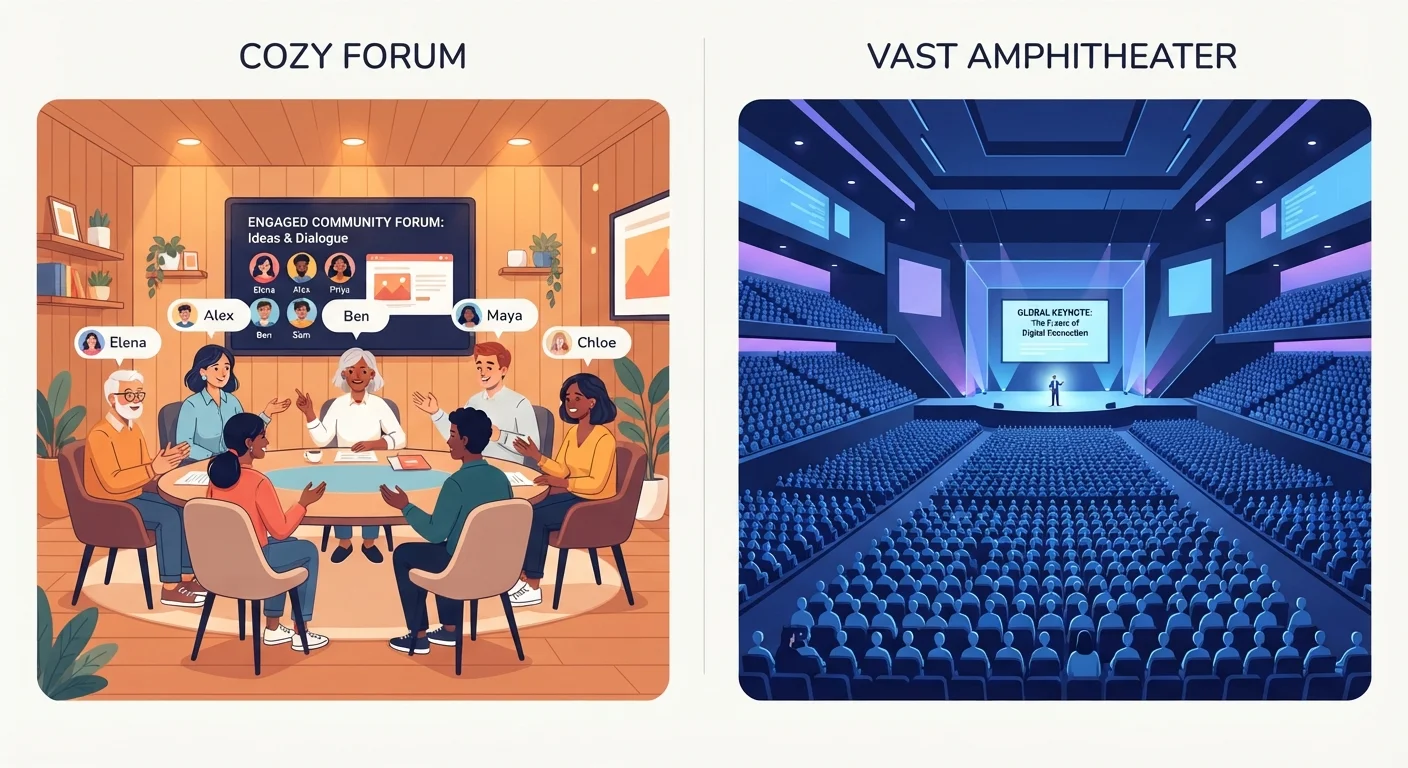
Photo credit: SyndicateExpert.com | Information At The Ready
In this article
A 200-person niche forum and a 2-million-member subreddit offer very different things. Learn what each environment does well and who thrives in each.
Key Takeaways
- Niche communities tend to foster stronger personal bonds and more specialized, relevant conversations.
- General communities offer greater content volume, faster responses, and more diverse viewpoints.
- Anonymity and scale in large communities can reduce accountability and increase noise.
- Small communities carry a risk of insularity or stagnation if growth slows.
- Your goals — belonging vs. information vs. discovery — should guide which type you join.
- Many people benefit from participating in both types at different points in their online life.
Why Audience Size Is More Than Just a Number
When you join an online community, one of the most consequential things about it isn't the platform it lives on or even its topic — it's its size. A 200-person forum dedicated to hand-dyeing yarn operates by entirely different social rules than a two-million-member subreddit about crafting in general. Understanding what makes online communities distinct from social media helps explain why scale matters so much.
In small spaces, members tend to recognize each other. Norms are reinforced through relationships, not just rules. In large spaces, you're often a stranger to everyone — which creates both freedom and distance. Neither is inherently better, but each shapes your experience in ways that are worth understanding before you invest your time.
| Criterion | Niche Communities | General Communities |
|---|---|---|
| Typical membership size | Dozens to a few thousand | Tens of thousands to millions |
| Sense of personal belonging | High — members recognize each other | Low — mostly anonymous interactions |
| Content relevance | Very high — tightly focused | Variable — broad and mixed |
| Response speed | Slower — smaller active base | Fast — always someone online |
| Diversity of viewpoints | Lower — shared assumptions common | Higher — wide range of perspectives |
| Accountability and norms | Strong — relationships enforce behavior | Weaker — harder to enforce at scale |
| Risk of insularity | Higher — echo chambers can form | Lower — constant influx of newcomers |
| Best for discovery | Limited — depth over breadth | Strong — surfaces adjacent topics |
What Niche Communities Do Exceptionally Well
The defining strength of a niche community is relevance. When everyone in the room cares about the same specific thing — whether that's restoring vintage motorcycles, parenting children with a rare diagnosis, or competitive speedrunning — conversations stay focused and genuinely useful. There's less need to explain context because shared vocabulary and shared assumptions already exist.
Psychologically, smaller groups tend to produce stronger feelings of belonging. Research in social psychology consistently shows that people form meaningful attachments more readily in smaller, higher-trust groups where they encounter the same individuals repeatedly. In niche spaces, your username becomes familiar. People remember your situation. That kind of recognition is rare in large communities and genuinely valuable for emotional wellbeing.
Niche communities are also where distinct digital subcultures do their most interesting work — building shared language, inside references, and norms that give membership real meaning. If you've ever felt like an outsider in mainstream spaces, a well-chosen niche community can feel like finally finding your people.
The trade-offs are real, though. Small communities can become insular or resistant to new perspectives. If membership stagnates, conversation loops. And if the community loses its moderators or its core contributors, it can collapse quickly.
What General Communities Offer That Small Ones Can't
Scale brings its own genuine advantages. A large, active community is almost always available — post a question at 2 a.m. and there's a good chance someone responds within minutes. The sheer volume of content means a broader range of experiences, skill levels, and viewpoints are represented. For topics where you want diversity of perspective rather than depth of consensus, that breadth is genuinely useful.
Large communities also serve as useful discovery engines. Browsing a high-traffic space can surface adjacent interests, introduce you to sub-communities you didn't know existed, and help you figure out what kind of people and conversations you actually want more of. Many people find their niche community precisely because they first encountered the topic in a general one.
That said, the social dynamics of large communities carry real costs. Anonymity at scale reduces accountability — behavior that would be called out in a tight-knit group can pass unnoticed in a crowd of thousands. Conversation quality tends to gravitate toward what gets the most engagement rather than what's most accurate or nuanced. And it's easy to lurk indefinitely without ever feeling like you belong. If you're wondering how different platform formats handle these dynamics, understanding how Reddit, Discord, and forums differ is a useful next step.
~150
Dunbar's number: stable social group limit
Anthropologist Robin Dunbar's research suggests humans can maintain meaningful relationships with roughly 150 people — a figure that helps explain why intimacy drops off in very large communities.
64%
Adults who find niche groups more trustworthy
A Pew Research Center survey found that a majority of online community participants felt smaller, interest-based groups were more civil and trustworthy than large social platforms.
1%
Typical active contributor rate in large communities
The '1% rule' in online participation research describes how in large communities, roughly 1% of members create content while the majority lurk — a dynamic far less pronounced in smaller groups.
Choosing the Right Environment for Your Goals
The most honest answer is that niche and general communities serve different needs — and many people benefit from both simultaneously. A useful way to think about it: general communities are often better for information and discovery, while niche communities are often better for belonging and depth.
If you're dealing with something emotionally weighty — a health challenge, a life transition, a relationship difficulty — a smaller, focused space is likely to offer more meaningful support. For a deeper look at what peer communities can genuinely provide in those moments, see our piece on what online support communities can and can't replace.
If you're exploring a broad interest, want quick answers, or are just curious what's out there, a larger community serves you well as a starting point. And if you're thinking about how online connections fit into your broader social life, it's worth reflecting on how digital belonging complements — rather than replaces — real-world friendship. The friendships and social life dimension of your wellbeing matters regardless of where you spend your online time.
The best community for you is ultimately the one where you feel genuinely seen — and that tends to be less about platform or size, and more about fit.

Author
Relationships & Community Editorial Team
Relationships & Community Editorial Team is the collective byline for our editorial team and contributor network. Articles published under this byline or an editorial pen name are researched, written, and reviewed according to our editorial standards for clarity, consistency, and independence before publication.
View all articles →