
Time Zone Reference: Major World Cities and Their UTC Offsets
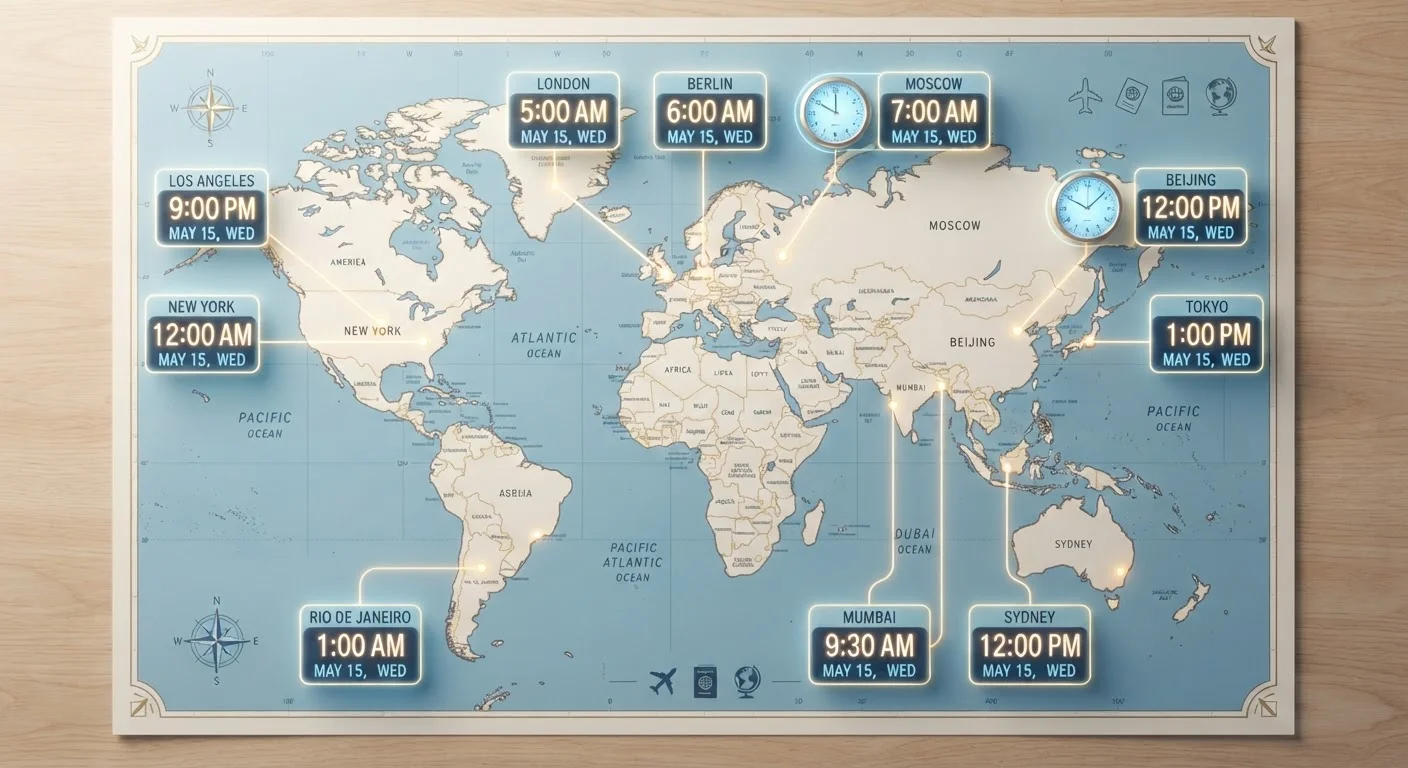
Photo credit: SyndicateExpert.com | Information At The Ready
In this article
A quick-reference guide to time zones in major travel destinations, including daylight saving time notes for cities that observe it.
How UTC Offsets Work
Every time zone on Earth is expressed as an offset from Coordinated Universal Time (UTC) — the global standard clock maintained by atomic timekeeping. An offset of UTC+5:30, for example, means a location is five and a half hours ahead of UTC; UTC−5 means five hours behind.
When traveling internationally, the key habit is calculating the difference between your home UTC offset and your destination's. Knowing that New York sits at UTC−5 (Eastern Standard Time) and Tokyo at UTC+9 makes the 14-hour gap immediately apparent — no guesswork required.
| Total number of UTC offsets in use worldwide | Approximately 40 (Including half-hour and quarter-hour offsets) |
| Countries that do not observe DST | Majority (roughly 140+) (Most equatorial and tropical nations stay on standard time year-round) |
| India's unique UTC offset | UTC+5:30 (One of the most widely used non-whole-hour offsets) |
| Nepal's UTC offset | UTC+5:45 (One of only a few quarter-hour offsets in the world) |
| US DST start (typically) | Second Sunday in March (Per US Energy Policy Act of 2005) |
| EU DST end (typically) | Last Sunday in October (European Union standard; subject to ongoing legislative review) |
Keep in mind that Daylight Saving Time (DST) shifts these offsets seasonally in many countries. The United States, most of Europe, and parts of Australia observe DST, while countries closer to the equator — including Japan, India, and most of Southeast Asia — do not observe it at all. Always verify the current local time through a reliable source before scheduling calls or flights.
Major World Cities: UTC Offset Reference
The table below lists commonly visited cities along with their standard UTC offsets. Cities marked with an asterisk (*) observe Daylight Saving Time during part of the year — their offsets shift by one hour during that period.
| City | Country/Region | Standard UTC Offset | DST Observed? |
|---|---|---|---|
| New York City | United States | UTC−5 | Yes (UTC−4 in summer) |
| Los Angeles | United States | UTC−8 | Yes (UTC−7 in summer) |
| Chicago | United States | UTC−6 | Yes (UTC−5 in summer) |
| London | United Kingdom | UTC+0 | Yes (UTC+1 in summer) |
| Paris / Berlin / Rome | Central Europe | UTC+1 | Yes (UTC+2 in summer) |
| Athens / Helsinki | Eastern Europe | UTC+2 | Yes (UTC+3 in summer) |
| Dubai | UAE | UTC+4 | No |
| Mumbai / New Delhi | India | UTC+5:30 | No |
| Bangkok / Jakarta | Southeast Asia | UTC+7 | No |
| Singapore / Kuala Lumpur | Southeast Asia | UTC+8 | No |
| Tokyo | Japan | UTC+9 | No |
| Sydney | Australia | UTC+10 / UTC+11 | Yes (Southern Hemisphere) |
| Auckland | New Zealand | UTC+12 / UTC+13 | Yes (Southern Hemisphere) |
| São Paulo | Brazil | UTC−3 | No longer observed (since 2019) |
| Mexico City | Mexico | UTC−6 | Mostly abolished (2023) |
Note: Mexico largely eliminated Daylight Saving Time in 2023, and Brazil ended DST in 2019. Always confirm current local policies with official government or airline sources before travel.
Practical Tips for Navigating Time Zones as a Traveler
Knowing your destination's UTC offset is just the start. Here's how to put that knowledge to work:
- Set a second clock. Most smartphones let you add a world clock for your destination. Switch your phone to local time as soon as you board — it helps your body and your schedule adjust faster.
- Translate key times before you leave. Write out the local equivalents for your flight departure, hotel check-in, and any reservations. A simple conversion note in your travel folder eliminates fumbling mid-journey.
- Watch the date line. Crossing the International Date Line (near UTC+12/UTC−12) can mean arriving a calendar day earlier or later than you departed. Factor this into any time-sensitive bookings.
- Account for half-hour and quarter-hour offsets. India (UTC+5:30), Iran (UTC+3:30), Nepal (UTC+5:45), and a handful of other destinations don't follow whole-hour increments — schedule calls accordingly.
- Verify DST transition dates. The US, EU, and Australia switch on different calendar dates, so there's a brief window each spring and autumn when the usual offset between two cities is temporarily different.
UTC (Coordinated Universal Time)
The primary global time standard used to regulate clocks worldwide. It does not observe Daylight Saving Time, making it the stable reference point from which all local time offsets are calculated.
UTC Offset
The difference in hours (and sometimes minutes) between a location's local time and UTC. Positive offsets are ahead of UTC; negative offsets are behind it.
Daylight Saving Time (DST)
A seasonal practice in which clocks are advanced by one hour during warmer months to extend evening daylight. Not all countries observe DST, and transition dates vary by region.
International Date Line
An imaginary line running roughly along the 180° meridian in the Pacific Ocean where the calendar date changes. Crossing it moving eastward subtracts a day; moving westward adds one.
Standard Time
A region's base UTC offset, in effect when Daylight Saving Time is not being observed. Also called 'winter time' in countries that shift clocks seasonally.
For real-time verification, official government time services and international airline scheduling tools are reliable references — especially for destinations where policies change, like those that have recently abolished or adjusted Daylight Saving Time.
This article is for general informational purposes only. Time zone policies and Daylight Saving Time rules are subject to change by local governments. Always verify current local times and policies with official sources before scheduling travel or time-sensitive commitments.

Author
Travel & Trips Editorial Team
Travel & Trips Editorial Team is the collective byline for our editorial team and contributor network. Articles published under this byline or an editorial pen name are researched, written, and reviewed according to our editorial standards for clarity, consistency, and independence before publication.
View all articles →