
Asset Allocation Across Life Stages: How Investment Priorities Shift
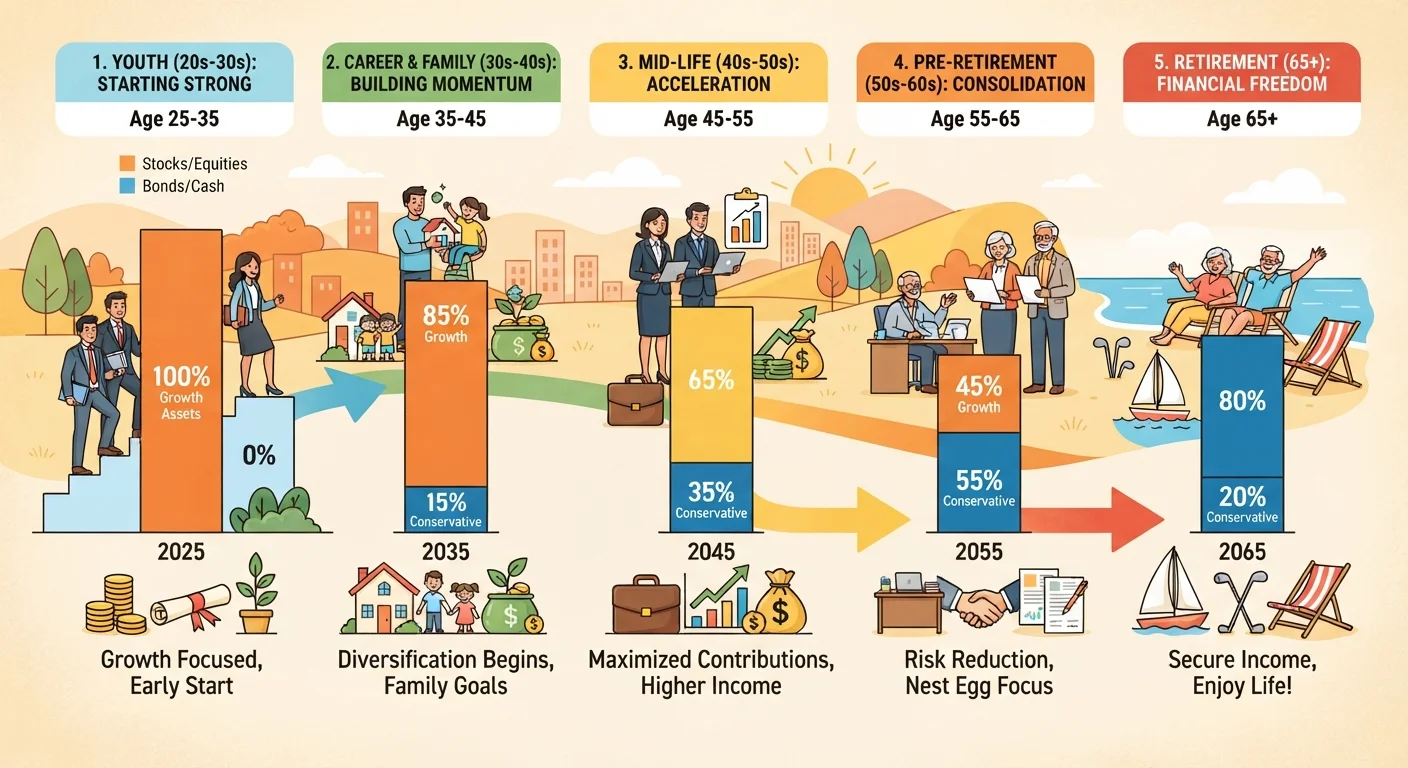
Photo credit: SyndicateExpert.com | Information At The Ready
The right mix of stocks, bonds, and other assets isn't fixed—it evolves with age, goals, and circumstances. Here's a framework for thinking it through.
Key Takeaways
- Asset allocation—how you divide investments among stocks, bonds, and cash—should change as you age.
- Younger investors generally tolerate more risk because they have more time to recover from market downturns.
- Rebalancing your portfolio periodically keeps your allocation aligned with your target mix.
- Life events like marriage, job changes, or approaching retirement are natural triggers to review your allocation.
- This article is general financial education—consult a licensed financial adviser for advice tailored to your situation.
Why Asset Allocation Matters at Every Age
Asset allocation refers to how you divide your investment portfolio among different asset classes—most commonly stocks (equities), bonds (fixed income), and cash equivalents. The proportion you hold in each category has a larger effect on long-term portfolio performance than picking individual securities, according to decades of investment research.
The core reason allocation needs to evolve is straightforward: your relationship with time changes. A 28-year-old investing for retirement has roughly 35–40 years for compounding to work and for temporary market drops to recover. A 62-year-old planning to retire in three years cannot afford to wait out a prolonged market decline. Risk tolerance, income stability, and spending needs all shift—and your portfolio should reflect that.
For a deeper look at how spreading investments across asset classes reduces exposure to any single loss, see our guide on diversification and long-term investing. And if any of the terminology here feels unfamiliar, our plain-language investing glossary is a useful starting point.
A Life-Stage Framework for Asset Allocation
The steps below map out how to think about allocation at different phases of your financial life. These are frameworks, not formulas—your personal circumstances will always require individual judgment.
Establish your time horizon and risk tolerance
Before choosing any specific allocation, answer two questions honestly: When will you need this money? and How would you react if your portfolio dropped 30% in a year?
Time horizon is the single most important input. Money you won't need for 20-plus years can ride out market cycles; money needed in five years or fewer generally cannot. Risk tolerance is partly emotional—a portfolio that causes you to panic-sell in downturns is the wrong portfolio, regardless of what a theoretical model suggests.
Early career (roughly ages 20s–mid-30s): Lean toward growth
With decades before retirement, most early-career investors can afford to hold a higher proportion of equities—broadly diversified stock funds rather than individual picks. Stocks carry more short-term volatility but have historically offered stronger long-term growth potential than bonds or cash. A common starting-point heuristic is to hold a stock allocation equal to 110 or 120 minus your age, though any rule of thumb is a rough guide, not a prescription.
Prioritise tax-advantaged accounts first. Contributions to a 401(k) up to any employer match are effectively an immediate return on your money. IRAs and HSAs offer additional tax benefits worth understanding early. Our comparison of tax-advantaged accounts explains the rules and limits for each.
Consistency matters more than timing. See why time in the market tends to outperform market timing.
Mid-career (roughly mid-30s–50s): Reassess as responsibilities grow
Mortgages, children, eldercare, and career transitions all affect how much risk you can realistically carry. As your portfolio grows in absolute value, a 30% market drop hurts more in dollars even if the percentage is the same. Gradually shifting a portion of your equity allocation into bonds or other lower-volatility assets can smooth out that exposure.
This is also the stage where life events—marriage, divorce, a major income change—should trigger a deliberate allocation review. Passive index funds can be an efficient, lower-cost vehicle for broad market exposure at this stage; our article on index funds versus actively managed funds outlines the trade-offs.
Pre-retirement (roughly 5–10 years out): Reduce sequence-of-returns risk
Sequence-of-returns risk is the danger that a major market decline early in retirement—when you begin drawing down savings—can permanently impair your portfolio even if markets eventually recover. To guard against this, most pre-retirees gradually increase their bond and cash allocation so that near-term spending needs aren't funded by assets that could be down 20–40% in a bear market.
A common approach is to keep one to three years of anticipated withdrawals in lower-risk assets, allowing equity holdings time to recover before you need to sell them.
Rebalance regularly to stay on track
Over time, asset classes grow at different rates, pulling your portfolio away from its target allocation. Rebalancing means selling some of what has grown and buying more of what has lagged to restore your intended mix. Most investors rebalance once or twice a year, or when any asset class drifts more than 5–10 percentage points from its target.
Inside tax-advantaged accounts, rebalancing has no immediate tax consequences. In taxable accounts, selling appreciated assets may trigger capital gains taxes, so factor that into your timing.
Life Events Are Natural Review Triggers
You don't need to review your allocation on a rigid schedule. Marriage, a new child, a job change, an inheritance, or a major health event are all meaningful reasons to reassess. Matching your portfolio to your current reality is more important than sticking to an arbitrary calendar.
Just as your body's nutritional and fitness needs shift across decades—as explored in our piece on physical health through every decade—your financial portfolio requires similarly thoughtful recalibration over time.
This article is for general informational and educational purposes only and does not constitute personalised financial, investment, tax, or legal advice. Consult a qualified, licensed financial professional before making decisions based on your individual circumstances.

Author
Personal Finance Editorial Team
Personal Finance Editorial Team is the collective byline for our editorial team and contributor network. Articles published under this byline or an editorial pen name are researched, written, and reviewed according to our editorial standards for clarity, consistency, and independence before publication.
View all articles →