
Weighing Up Home Workouts Against Gym Training
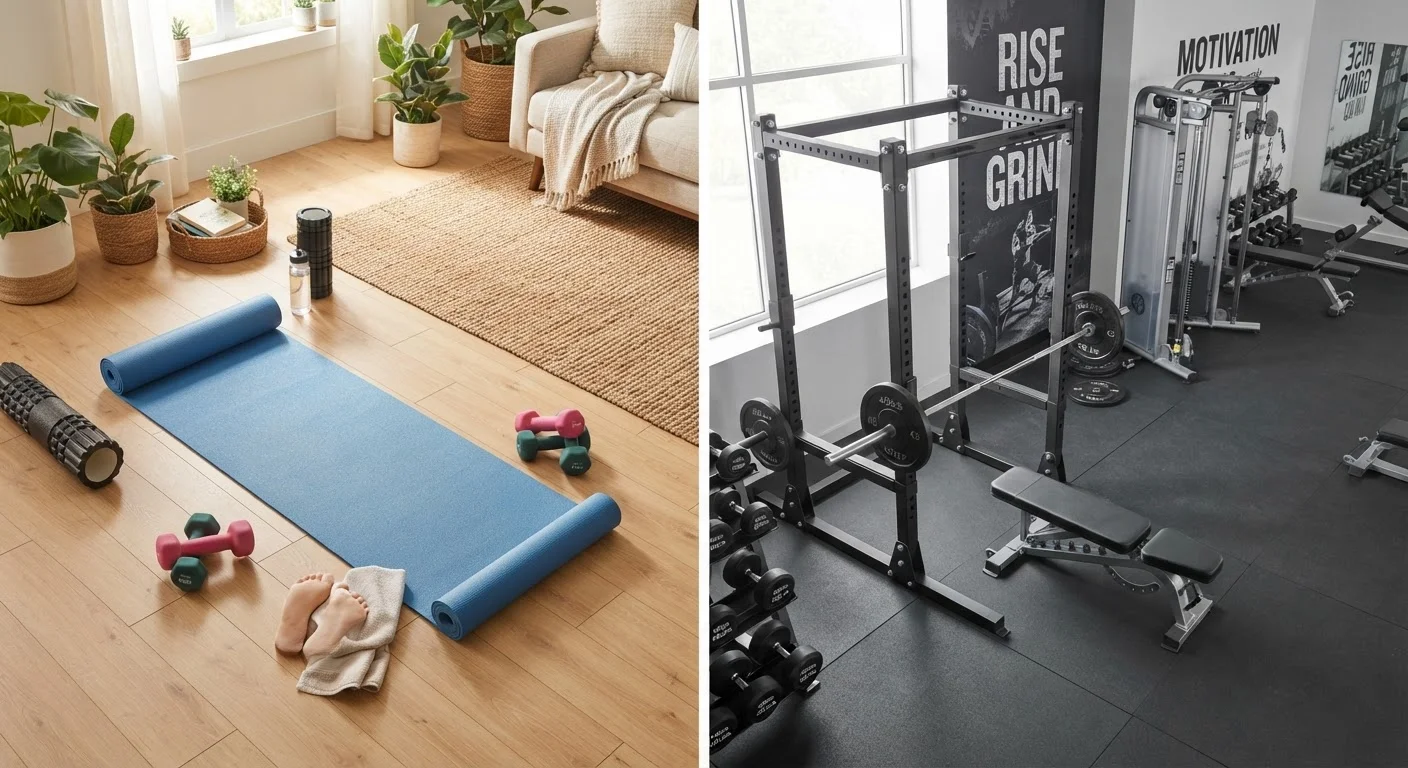
Photo credit: SyndicateExpert.com | Information At The Ready
In this article
Both home and gym environments offer real fitness benefits. This balanced look helps you understand the trade-offs so you can choose what fits your life.
Key Takeaways
- Home workouts eliminate commute time and gym fees, making consistency easier for busy schedules.
- Gyms provide access to progressive equipment and professional guidance that's difficult to replicate at home.
- Neither setting is objectively superior — effectiveness depends on individual goals, budget, and habits.
- Hybrid approaches, combining both environments, work well for many people long-term.
- Adherence matters more than environment: the workout you actually do beats the perfect one you skip.
No commute — exercise begins immediately
Removing travel time lowers the activation cost of starting a workout, which research links to higher exercise frequency over time.
Lower ongoing cost than most memberships
A basic home setup — mat, resistance bands, adjustable dumbbells — can cover years of training for less than many annual gym fees.
Complete scheduling flexibility
Training at 6 a.m., during a lunch break, or late at night is possible without worrying about facility hours or equipment availability.
Private environment reduces self-consciousness
Exercising away from public view allows people to experiment with new movements or recover confidence after a long break, supporting better adherence.
No waiting for equipment
At home, you use what you own on your own schedule — no queues for a squat rack or popular cardio machine during peak hours.
Limited equipment restricts long-term progression
Progressive overload becomes harder without access to a full range of resistance loads; purchasing heavier equipment significantly raises the cost and space requirements.
Household distractions can undermine focus
Children, chores, notifications, and domestic responsibilities compete for attention in ways that a dedicated gym environment eliminates by design.
No access to professional guidance on-site
Without a trainer nearby, form errors can go uncorrected, which increases injury risk particularly for complex compound lifts like deadlifts or overhead presses.
Harder to replicate gym's motivational atmosphere
The visual and social cues of a gym — seeing others train, ambient energy — can drive effort in ways that a home environment rarely reproduces naturally.
Space requirements may be prohibitive
Effective home training needs dedicated floor space; in smaller apartments or shared living arrangements, this is often not practical.
The Case for Home Workouts
Training at home removes two of the most commonly cited barriers to exercise: time and cost. Without a commute to a facility, a session can begin within minutes of deciding to move. Research consistently identifies time scarcity as a leading reason people abandon exercise routines, making this friction reduction genuinely meaningful rather than trivial.
Cost is equally significant. Gym memberships vary widely, but even modest annual fees represent a real expenditure. A modest set of resistance bands, a pair of adjustable dumbbells, and a yoga mat can support a broad range of training styles — from bodyweight circuits to foundational strength work — with little ongoing expense. For a deeper look at foundational strength movements you can perform in either setting, see our beginner's guide to strength training.
Privacy is another underappreciated advantage. Many people feel self-conscious in a gym, particularly when returning after a break or learning new movements. Training at home allows experimentation without social pressure, which can support better long-term adherence.
No commute — exercise begins immediately
Removing travel time lowers the activation cost of starting a workout, which research links to higher exercise frequency over time.
Lower ongoing cost than most memberships
A basic home setup — mat, resistance bands, adjustable dumbbells — can cover years of training for less than many annual gym fees.
Complete scheduling flexibility
Training at 6 a.m., during a lunch break, or late at night is possible without worrying about facility hours or equipment availability.
Private environment reduces self-consciousness
Exercising away from public view allows people to experiment with new movements or recover confidence after a long break, supporting better adherence.
No waiting for equipment
At home, you use what you own on your own schedule — no queues for a squat rack or popular cardio machine during peak hours.
The Case for Gym Training
Gyms exist precisely because some fitness goals are difficult to achieve without specialised equipment. Progressive overload — the principle of gradually increasing resistance to drive adaptation — is central to strength and muscle development. At home, progression eventually hits a ceiling unless you continue investing in heavier equipment. A gym provides barbells, cable machines, and weight stacks that allow continuous, fine-grained progression across years of training.
The social and environmental context of a gym also matters. For many people, being surrounded by others exercising creates a motivational cue that's hard to manufacture at home. Some research suggests that exercising alongside others can increase effort output, a phenomenon sometimes called the Köhler effect. Access to qualified trainers for form checks and programme design adds another layer of value that most home setups cannot offer.
Understanding how different exercise modalities affect the body can also sharpen your gym strategy — our article on aerobic vs. anaerobic exercise explains the physiological distinctions worth knowing.
Limited equipment restricts long-term progression
Progressive overload becomes harder without access to a full range of resistance loads; purchasing heavier equipment significantly raises the cost and space requirements.
Household distractions can undermine focus
Children, chores, notifications, and domestic responsibilities compete for attention in ways that a dedicated gym environment eliminates by design.
No access to professional guidance on-site
Without a trainer nearby, form errors can go uncorrected, which increases injury risk particularly for complex compound lifts like deadlifts or overhead presses.
Harder to replicate gym's motivational atmosphere
The visual and social cues of a gym — seeing others train, ambient energy — can drive effort in ways that a home environment rarely reproduces naturally.
Space requirements may be prohibitive
Effective home training needs dedicated floor space; in smaller apartments or shared living arrangements, this is often not practical.
What the Evidence Actually Says
Studies comparing home and gym-based exercise generally find that outcomes — including improvements in cardiovascular fitness, strength, and body composition — are similar when effort and volume are equated. In other words, the environment itself is less important than the quality and consistency of the training performed within it.
~83%
Adults who cite time as a barrier to exercise
U.S. surveys on exercise adherence consistently rank time constraints as the most commonly reported obstacle to regular physical activity.
Equivalent
Strength gains: home vs. gym when volume is matched
Multiple controlled studies have found no significant difference in strength or hypertrophy outcomes between home and gym training when total training volume and effort are equated.
~50%
New exercisers who quit within 6 months
Exercise adherence research suggests roughly half of people who begin a new fitness routine discontinue it within six months, regardless of where they train.
Consistency is the variable that most reliably predicts long-term results. A well-designed programme done at home three times a week will outperform an elaborate gym routine attended sporadically. For practical guidance on structuring a sustainable schedule, see our article on building a weekly exercise routine that actually sticks.
Recovery is equally critical regardless of where you train. Sleep and physical recovery are often the missing variables in plateauing fitness routines — worth reviewing if progress has stalled.
Making the Right Choice for Your Life
A few practical questions can help clarify which environment suits you better. Do you have a realistic space at home for the type of training you want to do? Is your nearest gym convenient enough to visit without planning around it? Are you someone who thrives alone or benefits from external structure and accountability?
Many people find that a hybrid model works best: maintaining a basic home setup for shorter sessions on busy days while using a gym for longer, more equipment-dependent workouts. This approach preserves flexibility without sacrificing access to heavier loads or professional support.
If you're returning to exercise after a significant gap, starting at home can reduce intimidation and allow you to rebuild habits before committing to a membership. Our guide on returning to exercise after a long break outlines how to progress safely in that situation.
This article is for general informational purposes only and is not a substitute for personalised advice from a qualified health or fitness professional. Consult a healthcare provider before starting a new exercise programme, especially if you have an existing health condition.

Author
Health & Wellness Editorial Team
Health & Wellness Editorial Team is the collective byline for our editorial team and contributor network. Articles published under this byline or an editorial pen name are researched, written, and reviewed according to our editorial standards for clarity, consistency, and independence before publication.
View all articles →