
Dollar-Cost Averaging: Investing Steadily Through Market Ups and Downs
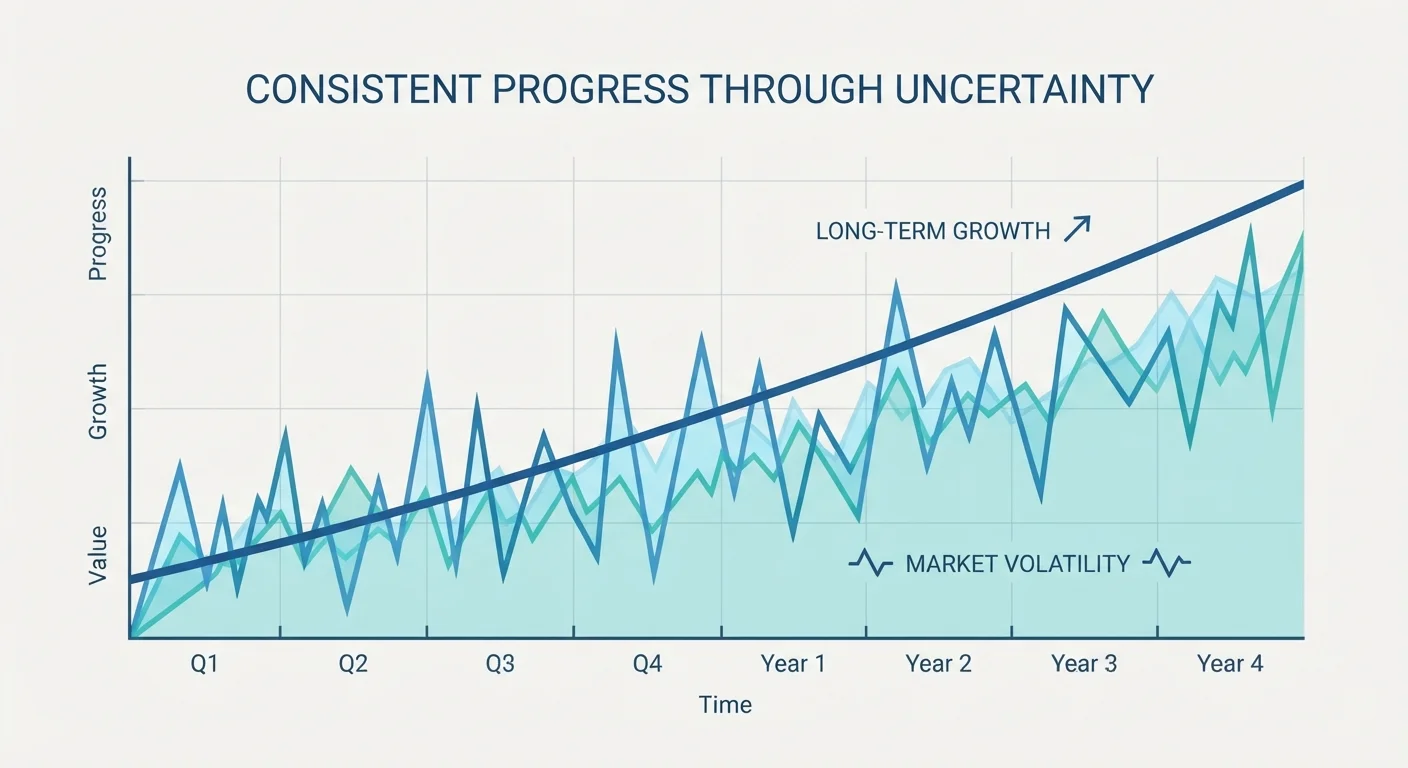
Photo credit: SyndicateExpert.com | Information At The Ready
In this article
Dollar-cost averaging is a disciplined strategy for investing regular amounts regardless of market conditions. Learn how it works and when it makes sense.
Key Takeaways
- Dollar-cost averaging invests a fixed amount on a regular schedule, removing the pressure of timing the market.
- The strategy automatically buys more shares when prices fall and fewer when prices rise.
- DCA helps reduce the emotional decision-making that often derails long-term investors.
- Many employer-sponsored retirement plans already use DCA automatically through payroll contributions.
- DCA is most effective when paired with a long investment horizon and a diversified portfolio.
- It does not eliminate risk or guarantee returns, but it can lower your average purchase cost over time.
How Dollar-Cost Averaging Works in Practice
Imagine you decide to invest $200 every month into a broad market index fund. In January, the fund's share price is $50 — your $200 buys 4 shares. In February, markets dip and the price falls to $40 — your $200 now buys 5 shares. In March, the price rebounds to $50 — you're back to 4 shares.
After three months, you've invested $600 and acquired 13 shares. Your average cost per share is roughly $46.15, even though the price opened and closed the period at $50. That's the mechanical advantage of DCA: lower prices automatically stretch your dollar further.
This approach removes the guesswork of deciding when to invest. Trying to predict market peaks and valleys — known as market timing — is notoriously difficult even for professional fund managers. DCA sidesteps that challenge entirely by making the schedule, not the market, the trigger for your investment.
For a solid financial foundation before you begin investing, see our complete guide to personal budgeting to ensure you have consistent surplus income to invest consistently each period.
The Behavioral Edge: Staying Calm When Markets Aren't
One of the most underappreciated benefits of dollar-cost averaging is psychological. Market downturns trigger anxiety, and anxiety leads to poor decisions — selling at a loss, sitting on cash too long, or abandoning an investment plan entirely. DCA combats this by turning investing into a routine rather than a judgment call.
When the schedule says invest, you invest. The market's mood is irrelevant to the transaction. Over years and decades, this consistency is often the single biggest differentiator between investors who build wealth and those who don't.
“The stock market is a device for transferring money from the impatient to the patient.”
— Warren Buffett, Chairman and CEO of Berkshire Hathaway, widely cited investor
Many investors also find it helpful to pair DCA with diversification — spreading contributions across different asset classes so no single holding derails the whole plan. Our explainer on diversification and long-term investing covers how that works in practice.
If you've hesitated to start investing because the market feels risky or unpredictable, you're not alone — and many of those hesitations are based on misconceptions. Our article on investing myths that keep everyday Americans on the sidelines addresses the most common ones directly.
When DCA Makes the Most Sense — and Its Limits
Dollar-cost averaging is particularly well-suited to investors who:
- Invest from regular employment income rather than a lump sum
- Have a long time horizon (generally 10 or more years)
- Want to reduce emotional decision-making
- Are building retirement savings through a 401(k) or IRA
In fact, if you contribute to a workplace retirement plan through payroll deductions, you're already using DCA — contributions are deducted each pay period automatically, regardless of market conditions.
DCA has limitations worth understanding. Studies have shown that when a large sum of money is available to invest, putting it all in at once statistically tends to outperform spreading it over time, because markets rise more often than they fall. If you receive an inheritance or a large bonus, consulting a licensed financial adviser about the appropriate approach for your specific situation is worthwhile.
DCA also does not eliminate the risk of loss. If the investments you choose perform poorly over the long run, consistent contributions won't overcome poor fundamentals. Selecting broadly diversified, low-cost investment vehicles and understanding basic investing terminology is essential — our plain-language investing jargon reference is a practical starting point.
~57%
U.S. workers with access to employer retirement plans
According to the U.S. Bureau of Labor Statistics, roughly 57% of private-sector workers have access to employer-sponsored retirement plans, which typically operate on a DCA structure through payroll deductions.
~66%
Investors who say emotions affect their decisions
A survey by Dalbar Inc. consistently shows that investor behavior — including panic selling during downturns — is a leading cause of underperformance relative to benchmark indices over long periods.
This article is for general informational and educational purposes only and does not constitute personalized financial, investment, tax, or legal advice. Past investment performance does not guarantee future results. Consult a qualified financial professional before making investment decisions.
Frequently Asked Questions

Author
Personal Finance Editorial Team
Personal Finance Editorial Team is the collective byline for our editorial team and contributor network. Articles published under this byline or an editorial pen name are researched, written, and reviewed according to our editorial standards for clarity, consistency, and independence before publication.
View all articles →