
Heating and Lighting for Reptile Enclosures: What Each System Actually Does
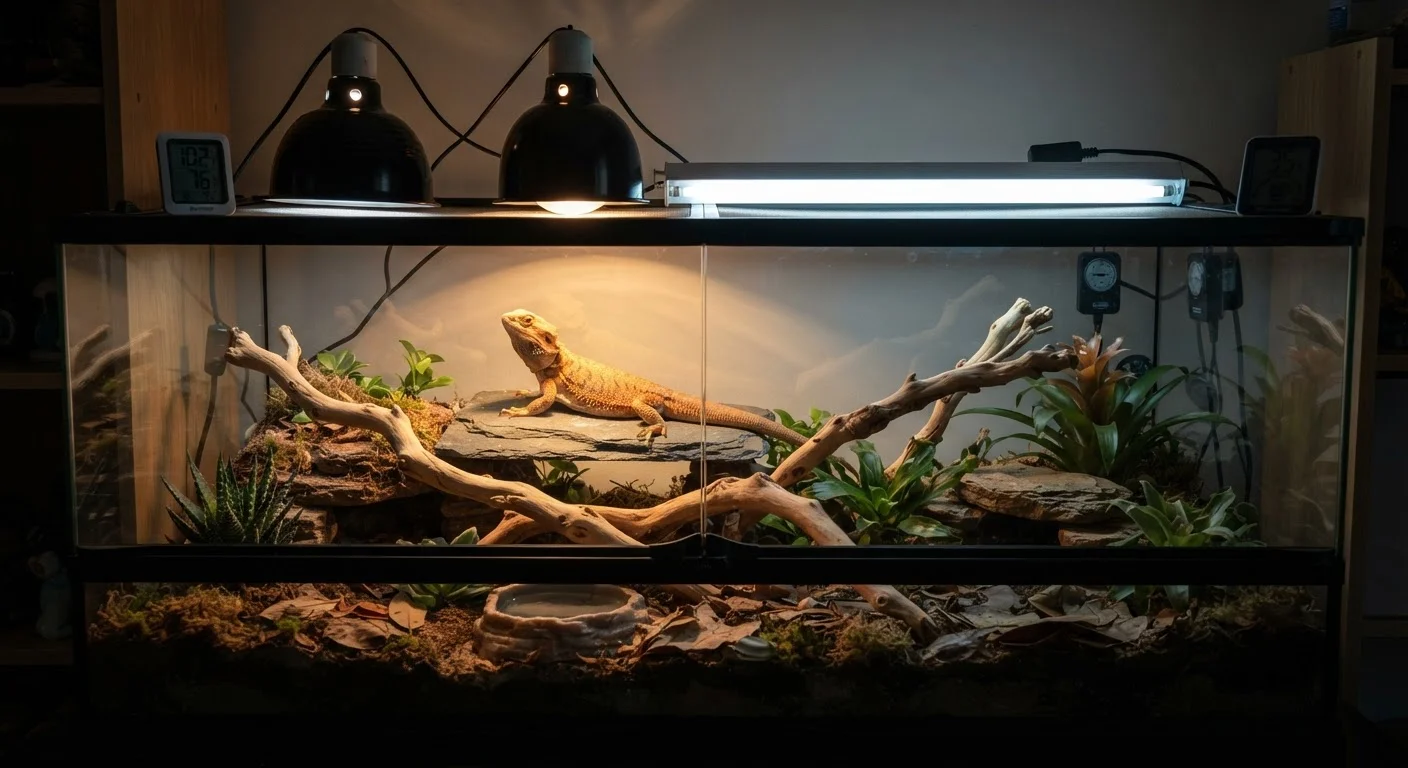
Photo credit: SyndicateExpert.com | Information At The Ready
In this article
UVB, basking bulbs, ceramic heat emitters — reptile lighting can feel overwhelming. This guide explains what each type does and which reptiles need what.
Key Takeaways
- Heat and light are biologically separate needs — one system rarely does both jobs adequately.
- UVB lighting is essential for most diurnal reptiles and cannot be replaced by diet alone in many species.
- Ceramic heat emitters provide warmth without light, making them suitable for overnight heating.
- Basking bulbs create a localized hot spot that allows reptiles to thermoregulate behaviorally.
- A proper thermal gradient — warm side to cool side — is as important as hitting a single target temperature.
- Always verify species-specific requirements before finalizing any enclosure setup.
Why Reptile Heating and Lighting Are Not the Same Thing
New reptile owners frequently conflate heat and light — understandably, since the sun delivers both simultaneously. In a vivarium, however, you need to think of them as separate systems solving separate biological problems.
Heat drives thermoregulation. Reptiles move between warmer and cooler zones in their enclosure to raise or lower their core body temperature, a behavior called behavioral thermoregulation. Without an adequate thermal gradient, they cannot digest food properly, mount immune responses, or maintain normal activity. Light — specifically UVB radiation — drives photobiological processes, most critically the skin synthesis of vitamin D3, which governs calcium metabolism. A reptile kept warm but without UVB can develop metabolic bone disease even if its enclosure temperature is perfect.
For a broader introduction to enclosure setup principles, see our beginner's guide to reptile keeping.
Basking Bulbs: Targeted Heat for Thermoregulation
A basking bulb — typically a halogen or incandescent-style lamp — creates a concentrated hot spot on a designated surface within the enclosure. When a bearded dragon or blue-tongued skink sits beneath it, the radiant heat warms the animal's body directly, mimicking the effect of sunbathing on a rock.
The temperature at the basking surface matters far more than ambient air temperature. Most basking species require surface temperatures between 95°F and 115°F depending on species — always confirm species-specific targets. Measure with an infrared temperature gun pointed at the basking surface itself, not the air above it.
Use a Thermostat on Every Heating Device
Plugging any heat source directly into a wall outlet without a thermostat removes your ability to regulate temperature precisely and creates a risk of dangerous overheating. Even basking bulbs benefit from dimming thermostats, which maintain target temperatures as ambient room conditions change. Thermostats are considered essential safety equipment in responsible reptile keeping.
Position the basking spot at one end of the enclosure only. This creates the warm-to-cool gradient your animal needs. Heating the entire enclosure uniformly removes the reptile's ability to regulate its own temperature and can be harmful.
UVB Lighting: More Than Just Visible Light
UVB lamps emit ultraviolet B radiation in the 290–320 nanometer range — invisible to the human eye but biologically critical for many reptiles. When UVB hits a reptile's skin, it triggers the synthesis of previtamin D3, which the body converts to active vitamin D3. This regulates calcium and phosphorus absorption from food.
Two main formats are widely used:
- Linear fluorescent tubes: Provide even UVB coverage across a wider area. Generally preferred for larger or active species. Available in different UVI (UV Index) output levels suited to different species' natural habitat exposure.
- Compact or coil UVB bulbs: Smaller and easier to fit into certain fixtures, but typically cover a smaller area and may have output inconsistencies. The Ferguson Zone system — developed by herpetologist Dr. Gary Ferguson — categorizes reptile species by their natural UV exposure levels and is a useful reference for matching bulb output to species need.
UVB output declines over time even when a bulb still emits visible light. Replace bulbs on the manufacturer's recommended schedule, or test output with a UV meter.
6–12 months
Typical UVB bulb replacement interval
Most UVB fluorescent tube manufacturers recommend replacement every 6 to 12 months, as UV output degrades significantly before visible light fails.
4
Ferguson Zones categorizing reptile UV exposure
The Ferguson Zone system, developed through field UV index measurements of reptile basking behavior, classifies species from Zone 1 (low UV, shade-dwellers) to Zone 4 (high UV, open baskers).
~65°F
Minimum safe nighttime temperature for many tropical species
General husbandry guidance for many tropical reptiles suggests ambient nighttime temps should not fall below approximately 65°F, though species-specific thresholds vary.
Ceramic Heat Emitters, Heat Mats, and Radiant Heat Panels
Not all heating happens during daylight hours, and not all heat sources should produce visible light.
Ceramic heat emitters (CHEs) screw into a standard ceramic lamp socket and radiate infrared heat without any glow. They are commonly used to maintain safe overnight temperatures in species that require it, without disrupting the animal's dark cycle. CHEs get extremely hot and must be used with a thermostat and a ceramic (not plastic) fixture.
Under-tank heat mats warm the substrate or glass floor of an enclosure. They are most appropriate for species that thermoregulate through contact with warm ground (like some colubrids and many geckos) rather than through basking under overhead heat. A thermostat is non-negotiable — unregulated heat mats have been implicated in burns and fires.
Radiant heat panels (RHPs) mount inside the top of a wooden enclosure and radiate heat downward from above, similar to a basking lamp but without visible light. They are popular for larger arboreal species in taller enclosures.
All heating devices should be connected to a thermostat calibrated for the specific device type (on/off stats for CHEs and mats; dimming or proportional stats for basking bulbs).
Matching Systems to Species
No single heating or lighting configuration suits every reptile. Requirements vary dramatically by species, origin habitat, and natural activity pattern.
| Species Type | Basking Heat | UVB Needed | Nighttime Heat |
|---|---|---|---|
| Bearded dragon (diurnal desert) | Yes — high output | Yes — high UVI | Only if temps drop below ~65°F |
| Leopard gecko (crepuscular) | Belly heat preferred | Low-level UVB beneficial | Mild heat mat or CHE |
| Ball python (nocturnal) | Ambient warmth sufficient | Low-level UVB beneficial | Yes — ambient must stay warm |
| Green iguana (diurnal tropical) | Yes — very high output | Yes — high UVI | May need CHE or RHP |
This table is a general orientation only. Always research the specific subspecies or regional variant you keep, and consult a reptile-experienced veterinarian for health concerns. For guidance on enriching your reptile's environment beyond heat and light, see our practical guide to reptile handling and enrichment.
This article is for general informational purposes only. For concerns about your reptile's health, consult a veterinarian with experience in exotic or reptile medicine.
Frequently Asked Questions

Author
Pets & Animals Editorial Team
Pets & Animals Editorial Team is the collective byline for our editorial team and contributor network. Articles published under this byline or an editorial pen name are researched, written, and reviewed according to our editorial standards for clarity, consistency, and independence before publication.
View all articles →