
What the Numbers on Your Speedometer Actually Mean for Safety
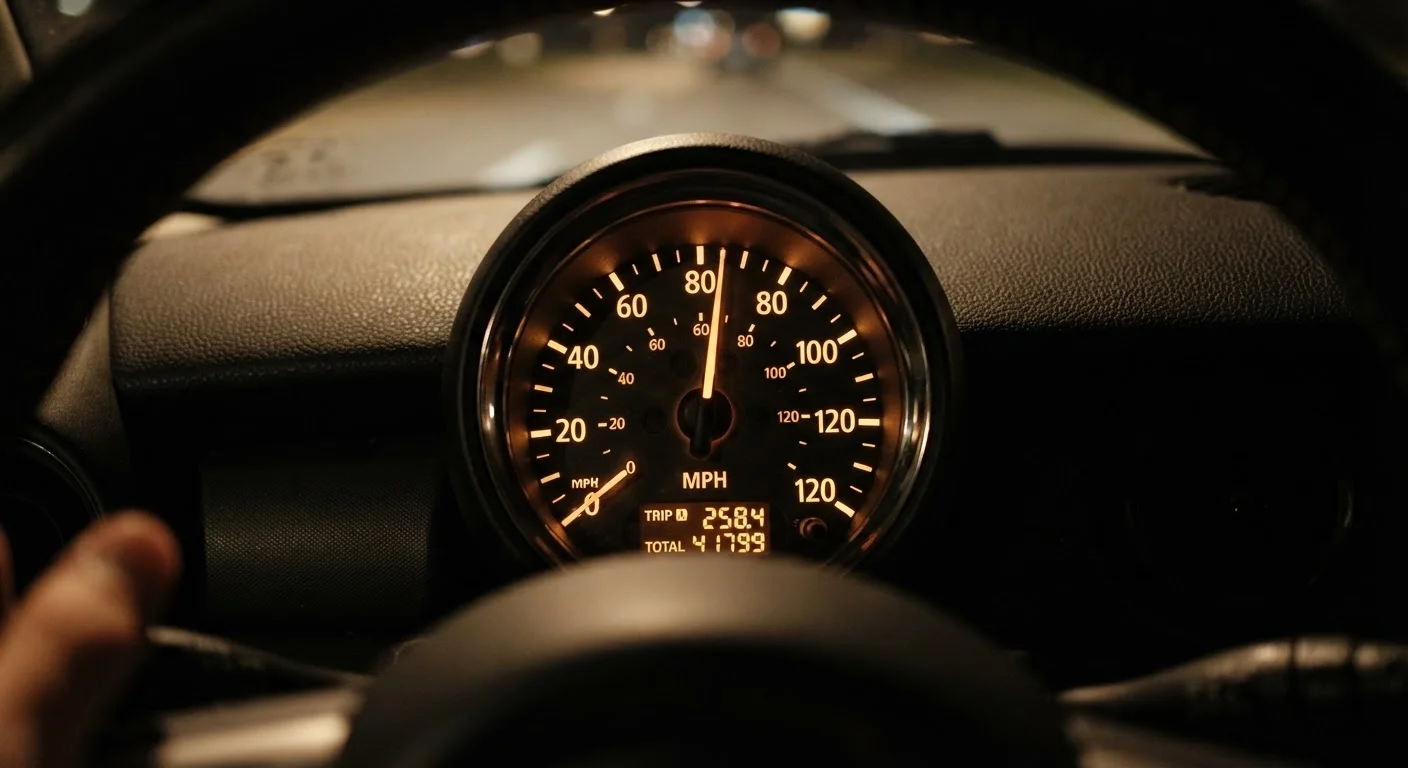
Photo credit: SyndicateExpert.com | Information At The Ready
In this article
Speed limits, stopping distances, and reaction time — here's what the science behind your speedometer really tells you about driving safely.
Key Takeaways
- Braking distance increases exponentially, not linearly, as speed rises.
- At 60 mph, most drivers need roughly 240–300 feet to come to a complete stop.
- Reaction time alone consumes 1–1.5 seconds before braking even begins.
- Speed limits are set using traffic engineering studies, crash data, and road design factors.
- Even small speed reductions — just 5–10 mph — significantly lower crash severity.
- Conditions like rain, night, or fatigue effectively shrink your safe speed margin.
Speed Is a Physics Problem, Not Just a Legal One
Most drivers think of the speedometer primarily in legal terms — stay under the posted number, avoid a ticket. But the numbers on that dial describe something more fundamental: how much energy your vehicle carries, how far it will travel before stopping, and how little time you have to respond to danger.
Kinetic energy — the force your moving vehicle carries — increases with the square of speed. That means a car traveling at 60 mph carries four times the energy of the same car at 30 mph, not twice. In a collision, that energy has to go somewhere. The higher your speed, the more destructive force is released into the vehicle structure, safety systems, and occupants.
This is why traffic safety researchers consistently find that even modest speed reductions produce outsized reductions in crash fatality risk. According to the Insurance Institute for Highway Safety, the risk of death in a pedestrian crash roughly doubles between 30 mph and 45 mph. Speed is never just a number.
4×
Energy increase from doubling speed
Kinetic energy scales with the square of velocity — doubling speed quadruples the energy released in a crash.
~300 ft
Total stopping distance at 60 mph
On dry pavement with average reaction time, most passenger vehicles need 250–300 feet to stop from 60 mph.
50%+
Braking distance increase on wet roads
Wet pavement significantly reduces tire friction, often extending stopping distances by half or more compared to dry conditions.
132 ft
Reaction distance at 60 mph
Assuming a 1.5-second average reaction time, a vehicle travels over 130 feet before the driver's foot even reaches the brake pedal.
Breaking Down Stopping Distance
When you decide to brake, your car doesn't stop instantly — two separate distances are at work before you come to a halt.
Reaction distance is how far your vehicle travels during the time it takes your brain to recognize a hazard and your foot to reach the brake pedal. For most alert drivers, this averages about 1.5 seconds. At 60 mph, that's roughly 132 feet of travel before braking even begins.
Braking distance is the additional distance the car slides as the brakes engage and friction slows the vehicle. On dry pavement with functioning brakes, this is approximately another 120–170 feet at 60 mph, depending on the vehicle and tires. Combined, you're looking at 250–300 feet — about the length of a football field — just to stop from highway speed.
Wet or icy roads can extend that figure dramatically. This is exactly why tailgating at highway speeds is so dangerous: the margin for error evaporates at 65–70 mph, even in a well-maintained vehicle.
How Speed Limits Are Actually Set
Speed limits in the United States aren't arbitrary — they're established through traffic engineering studies that account for road design, pedestrian activity, crash history, and the natural behavior of drivers on that specific road.
A common method is the 85th percentile rule: engineers study the speed at or below which 85% of drivers naturally travel under free-flow conditions, then use that figure as a baseline for setting the limit. The idea is that the majority of drivers self-select a reasonably safe speed for conditions, and the limit should reflect that reality while also accounting for outliers.
School zones, residential streets, and work zones carry lower limits because of increased pedestrian exposure, limited sightlines, and the higher vulnerability of the people present. Understanding the reasoning behind a posted limit — rather than viewing it as an arbitrary ceiling — helps drivers make better judgments when conditions differ from the norm. As noted in our guide to night driving hazards, the posted limit assumes visibility and conditions that don't always exist after dark.
When the Right Speed Is Below the Limit
Speed limits represent the legal maximum under ideal conditions — not a prescription for every situation. Experienced, safety-conscious drivers treat them as a ceiling, not a target.
Several conditions call for speeds well below the posted limit:
- Rain and wet roads: Hydroplaning risk increases above 35 mph on standing water. Braking distance can increase by 50% or more on wet pavement.
- Poor visibility: Fog, heavy rain, and glare reduce the distance at which you can perceive hazards, effectively shortening your usable reaction time.
- Curves and hills: Road geometry affects how quickly your tires can shed speed while maintaining traction. Sharp curves designed for 35 mph are unsafe at 50 mph regardless of the posted limit.
- Driver fatigue: Reaction time degrades measurably with tiredness. Older drivers may experience additional changes — see our discussion of how aging affects reaction time and road safety.
Use the 3-Second Rule as Your Baseline
In dry, clear conditions at highway speeds, maintain at least a 3-second following gap from the vehicle ahead. Pick a fixed landmark, watch the car in front pass it, then count — if you reach it in under 3 seconds, you're too close. In rain, fog, or at night, extend this to 4–6 seconds to account for longer braking distances.
The core principle: your safe speed is the one that gives you enough time and distance to respond to whatever you can see in front of you. When conditions shrink your visibility or traction, your safe speed drops accordingly, independent of what the sign says.
Frequently Asked Questions

Author
Cars & Driving Editorial Team
Cars & Driving Editorial Team is the collective byline for our editorial team and contributor network. Articles published under this byline or an editorial pen name are researched, written, and reviewed according to our editorial standards for clarity, consistency, and independence before publication.
View all articles →