
Index Funds vs. Actively Managed Funds: What the Evidence Says
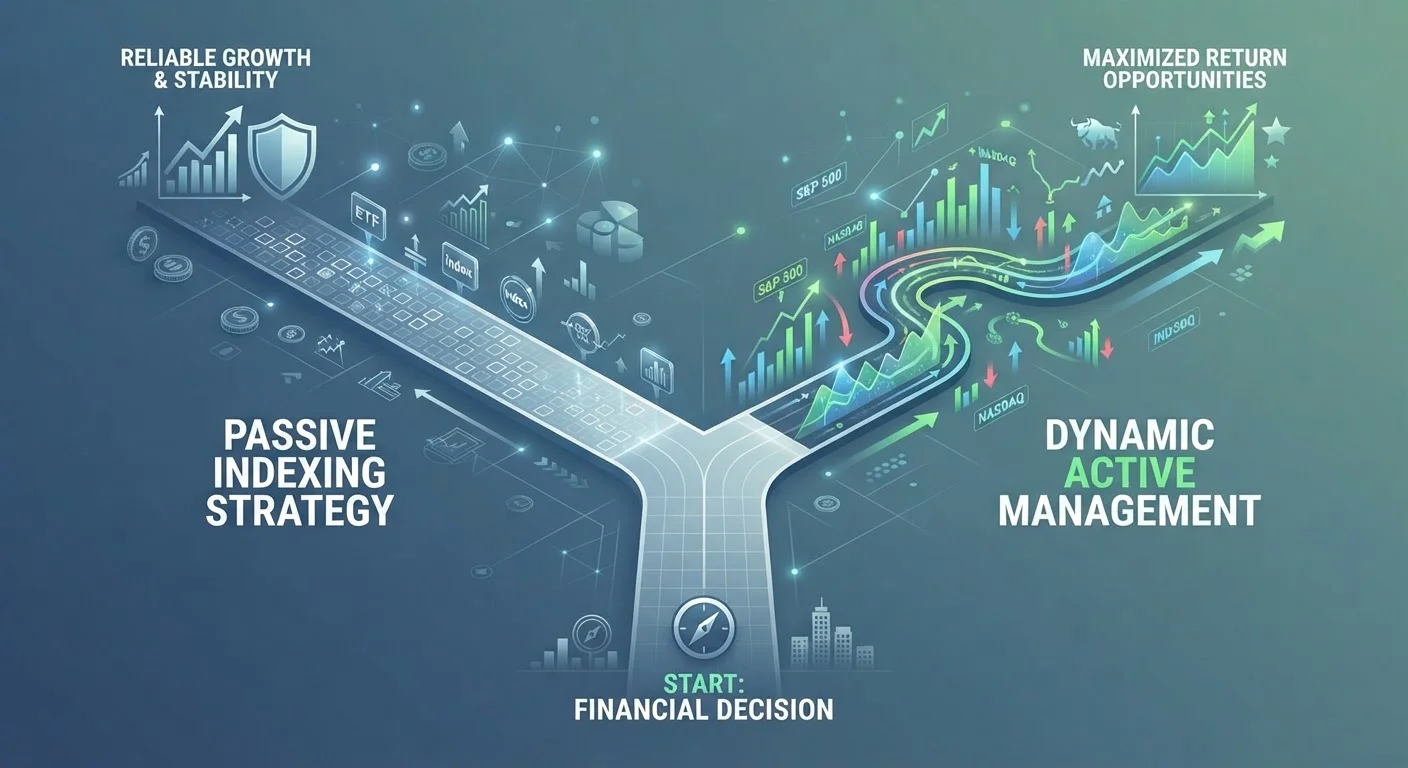
Photo credit: SyndicateExpert.com | Information At The Ready
In this article
A clear-eyed look at how passive index funds and actively managed funds differ in cost, risk, and long-term performance across market conditions.
Key Takeaways
- Index funds track a market benchmark passively; actively managed funds rely on managers making investment decisions.
- Expense ratios for index funds are typically far lower than those for actively managed funds.
- Research consistently shows most actively managed funds underperform their benchmark index over long periods.
- Tax efficiency generally favors index funds due to lower portfolio turnover.
- Neither approach is universally superior — your time horizon, goals, and costs should guide your choice.
- This article is general financial education, not personalized investment advice — consult a licensed adviser for your situation.
How Each Approach Works
An index fund is a fund designed to replicate the performance of a specific market index — for example, a broad stock market index or a bond market index. The fund holds the same securities, in roughly the same proportions, as the index it tracks. Because no manager is making active stock-picking decisions, costs stay low and portfolio turnover is minimal. If you're new to terms like expense ratio or turnover, see our plain-language investing glossary for clear definitions.
An actively managed fund, by contrast, employs a portfolio manager — or a team — who researches securities, forms views on their prospects, and builds a portfolio intended to outperform a stated benchmark. That expertise and research infrastructure costs money, reflected in higher fees passed on to investors.
The philosophical difference matters: index investing assumes markets are largely efficient and that consistent outperformance is very difficult to achieve reliably. Active management assumes skilled analysis can identify mispriced securities and exploit those gaps. Both assumptions have some truth in them — the question is which assumption best serves your long-term financial goals.
What the Performance Evidence Shows
Decades of independent research point in a consistent direction: the majority of actively managed funds underperform their benchmark index over long time periods, particularly after fees. Reports such as the S&P Dow Jones SPIVA (S&P Indices Versus Active) scorecards, published regularly, have tracked this gap across fund categories and time horizons, finding that underperformance rates tend to increase the longer the measurement window.
~85%
Active large-cap funds underperforming over 15 years
S&P Dow Jones SPIVA reports have repeatedly found that over 15-year periods, the large majority of actively managed U.S. large-cap funds trail their benchmark index after fees.
0.03%–1.00%+
Expense ratio range: index vs. active funds
Broad-market index funds commonly carry expense ratios under 0.10%, while actively managed equity funds frequently charge 0.50% to over 1.00% annually.
Low
Persistence of active fund outperformance
Research into performance persistence generally finds that prior-year top-performing active funds are unlikely to repeat that ranking in subsequent years at rates above chance.
This doesn't mean every active fund underperforms — some do beat their benchmark, and some managers have sustained records. The challenge for investors is identifying those managers in advance, rather than after the fact. Research into performance persistence suggests that past outperformance is a weak predictor of future outperformance, making selection difficult.
Active funds tend to show relatively better results in market segments where information is less uniform — smaller companies, emerging market equities, or niche sectors — compared to large, heavily analyzed domestic stocks where pricing is generally more efficient. Still, fees remain a headwind even in these areas. Our article on hidden investment account costs explains how seemingly small fee differences compound significantly over time.
The Cost Gap and Why It Compounds
Cost is arguably the most reliable differentiator between the two approaches. Index funds routinely carry expense ratios (the annual percentage of assets charged as fees) well below 0.20%, with many broad-market options far lower. Actively managed funds commonly charge between 0.50% and 1.00% or more annually, and some carry additional sales charges or performance fees.
That gap may sound small in a given year, but compounding works against the higher-cost fund relentlessly over time. A difference of 0.70 percentage points annually, applied to a growing portfolio over 20 or 30 years, can translate into a substantial reduction in final account value — without any difference in gross market returns. Investors who have felt confused by these charges will find our piece on the real costs inside investment accounts a useful companion read.
Tax efficiency is a related consideration. Index funds trade infrequently, generating fewer taxable capital gains events distributed to fund shareholders. Actively managed funds, which buy and sell holdings more often, can generate higher annual tax bills in taxable (non-retirement) accounts — another drag on net returns.
Choosing What Fits Your Situation
Neither index funds nor actively managed funds are the right answer for every investor in every situation. Several factors are worth thinking through:
- Time horizon: The longer your horizon, the more the cost advantage of index funds compounds. Short-term tactical goals may have different requirements.
- Account type: In tax-advantaged retirement accounts, the tax-efficiency edge of index funds matters less than in taxable brokerage accounts.
- Market segment: In highly efficient large-cap markets, passive strategies face less competition from active funds. In less efficient segments, the case for active management is at least worth examining.
- Your own involvement: Index fund investing is highly compatible with a hands-off approach. Active fund investing still requires periodic evaluation of fund performance and management changes.
It's also worth knowing that many investors hold a mix of both. A core portfolio of index funds might be complemented by an actively managed fund in a specific niche — an approach sometimes called a "core-satellite" strategy. As your portfolio evolves over time, revisiting how your assets are allocated is important; our guide on asset allocation across life stages offers a useful framework for that thinking.
If you've been hesitant to invest at all, it may help to know that both approaches are far more accessible than many people assume. Our article on common investing myths addresses several misconceptions that can keep people on the sidelines longer than necessary.
This article is for general informational and educational purposes only and does not constitute personalized investment, tax, or legal advice. Investing involves risk, including the possible loss of principal. Past performance does not guarantee future results. Please consult a qualified, licensed financial adviser before making investment decisions based on your individual circumstances.

Author
Personal Finance Editorial Team
Personal Finance Editorial Team is the collective byline for our editorial team and contributor network. Articles published under this byline or an editorial pen name are researched, written, and reviewed according to our editorial standards for clarity, consistency, and independence before publication.
View all articles →