
Dog Nutrition Labels Decoded: What You're Actually Feeding Your Pet
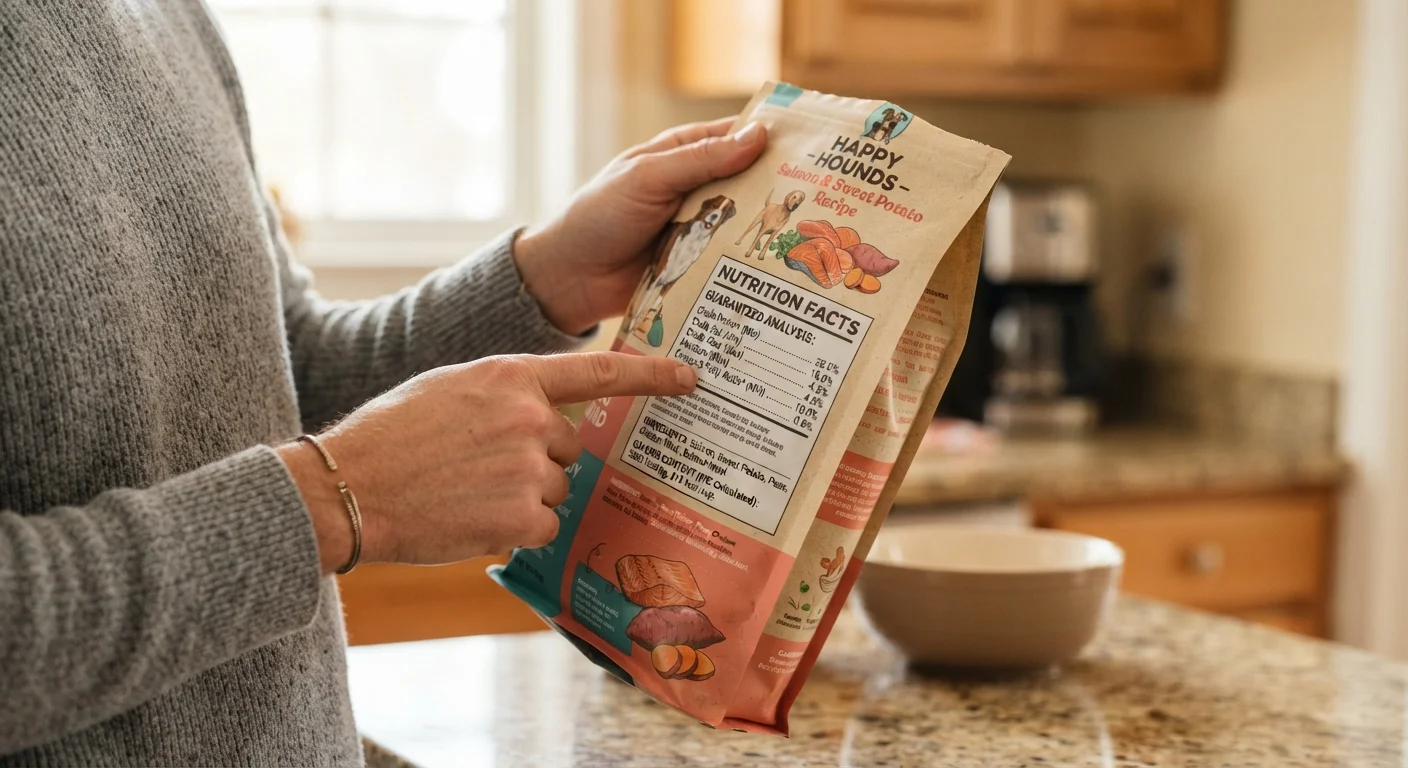
Photo credit: SyndicateExpert.com | Information At The Ready
In this article
Ingredient lists, guaranteed analysis, AAFCO statements — this guide demystifies what dog food labels mean and what to look for.
Key Takeaways
- Ingredients are listed by weight before processing, so moisture content affects where meat appears on the list.
- The guaranteed analysis shows minimum or maximum nutrient percentages, not exact amounts.
- An AAFCO nutritional adequacy statement tells you whether a food is complete and balanced — and for which life stage.
- "Chicken flavor" and "with chicken" legally mean far less chicken than foods simply named "Chicken for Dogs."
- Dry matter basis comparisons let you fairly evaluate wet and dry foods side by side.
- Always consult your veterinarian before changing your dog's diet, especially for puppies, seniors, or dogs with health conditions.
The Five Label Sections Every Owner Should Know
Every bag or can of commercial dog food sold in the U.S. must carry five core label elements. Knowing what each one is and does helps you move beyond marketing claims to the actual data.
- Product name: Tightly regulated by AAFCO naming rules (more on this below).
- Ingredient list: All ingredients in descending order by pre-cooking weight.
- Guaranteed analysis: Minimum or maximum percentages of key nutrients.
- Nutritional adequacy statement: Whether the food is complete, balanced, and for which life stage.
- Feeding directions and calorie statement: Guidance on portion sizing and energy density.
The FDA oversees pet food safety at the federal level, while AAFCO model regulations — adopted by most states — define standards for labeling, ingredient definitions, and nutrient profiles. No single federal agency pre-approves individual pet food formulations before they reach shelves, which makes label literacy especially important for owners.
AAFCO Sets Standards — It Doesn't Approve Foods
AAFCO is a voluntary membership organization of state and federal feed control officials that develops model regulations and nutrient profiles. It does not test, certify, or pre-approve individual pet food products. When a label claims to "meet AAFCO nutrient profiles," that determination is made by the manufacturer, not by a third-party regulatory body. Independent third-party testing, when available, can offer additional assurance.
Decoding the Ingredient List
Ingredients are listed by weight before processing. This matters because raw meat contains a large amount of water — sometimes 70% or more — so a chicken listed first may rank lower than grains once moisture is removed during manufacturing. This is sometimes called ingredient splitting when manufacturers list multiple forms of a carbohydrate separately (e.g., ground corn, corn gluten meal, corn bran) to push each one lower on the list.
AAFCO naming rules create meaningful distinctions in product names:
- "Chicken for Dogs" or "Chicken Dog Food": Chicken must make up at least 95% of the total product weight (excluding water).
- "Chicken Dinner," "Chicken Entrée," "Chicken Platter": The named ingredient must be at least 25% of the product.
- "With Chicken": Only 3% chicken is required.
- "Chicken Flavor": No minimum amount — just enough to be detectable.
Named by-products such as chicken by-product meal are defined by AAFCO and include organ meats and other parts — nutrient-dense components that are a standard part of many complete diets. Generic terms like "meat by-products" without a named species are less transparent and worth noting.
Understanding the Guaranteed Analysis
The guaranteed analysis panel lists four required nutrients: crude protein (minimum), crude fat (minimum), crude fiber (maximum), and moisture (maximum). Some manufacturers voluntarily add others, such as omega fatty acids or specific minerals.
These are guaranteed thresholds — floors and ceilings — not exact values. A food showing 26% minimum crude protein may actually contain more. Fiber maximums tell you a product won't exceed that level, but the actual content could be lower.
Comparing a wet food to a dry food using the label percentages alone is misleading because wet food may contain 75–80% moisture. To compare them fairly, convert both to dry matter basis: subtract the moisture percentage from 100 to get the dry matter percentage, then divide the nutrient value by that number. For example, a wet food with 8% protein and 78% moisture has (8 ÷ 22) × 100 = 36.4% protein on a dry matter basis — potentially more protein-dense than it first appears.
95%
Minimum named-ingredient content for a single-ingredient product name
Under AAFCO model regulations, a product simply named "Chicken for Dogs" must contain at least 95% chicken by weight, excluding added water.
3%
Minimum named-ingredient content for "with" claims
A label reading "with chicken" is only required to contain 3% of that ingredient under AAFCO naming rules — a fraction of what the name implies.
4
Nutrients required in every guaranteed analysis panel
FDA regulations mandate that all commercial dog food labels disclose crude protein, crude fat, crude fiber, and moisture at minimum.
The AAFCO Nutritional Adequacy Statement
This statement — sometimes called the "complete and balanced" claim — is arguably the most important line on the label. It appears in two forms:
- Formulated to meet: The food was mathematically verified against AAFCO nutrient profiles. This is more common and less expensive for manufacturers than feeding trials.
- Animal feeding tests using AAFCO procedures: The food was fed to real dogs and monitored for health outcomes over a defined period. Generally considered the higher bar.
The statement also specifies the life stage: growth (puppies), adult maintenance, reproduction, or all life stages. A food labeled only for adult maintenance has not been validated for puppies or pregnant dogs and should not be fed to them without veterinary guidance. "All life stages" must meet the more demanding puppy and reproduction profiles.
Foods labeled as "complementary" or "intermittent feeding" are not complete and balanced and should not serve as a dog's primary diet. This designation often applies to treats, toppers, and some raw food products.
For more on how your dog's overall health connects to daily care decisions, see our overview of dog vaccination schedules — another area where label-style guidance can feel opaque without context.
What the Label Can't Tell You
Nutrition labels reflect legal minimums and averages — they don't capture ingredient quality, sourcing, manufacturing oversight, or digestibility. Two foods with identical guaranteed analyses can differ meaningfully in how well a dog absorbs and uses those nutrients.
Labels also don't reflect your individual dog's needs. A senior dog with kidney considerations, a puppy still growing, or a dog with a diagnosed food sensitivity each requires a different nutritional approach. If your dog shows signs of digestive upset, unusual eating behavior, or coat changes after a food switch, those are cues worth discussing with a veterinarian. You might also find it useful to observe why dogs sometimes eat grass, which can occasionally signal a dietary issue.
If you're curious how human food label rules compare, the framework is surprisingly different — see our field guide to human nutrition labels for context. And for a look at how feline dietary needs diverge from canine ones, cat nutrition has its own distinct requirements worth understanding.
Use the label as a starting point, not a final verdict. A veterinarian or board-certified veterinary nutritionist can help you evaluate whether a food is a good fit for your specific dog's age, size, health history, and activity level.
This article is for general informational purposes only and is not a substitute for professional veterinary advice. Always consult a licensed veterinarian before making significant changes to your dog's diet.
Frequently Asked Questions

Author
Pets & Animals Editorial Team
Pets & Animals Editorial Team is the collective byline for our editorial team and contributor network. Articles published under this byline or an editorial pen name are researched, written, and reviewed according to our editorial standards for clarity, consistency, and independence before publication.
View all articles →