
Why Cats Knock Things Off Tables — and What It Actually Means
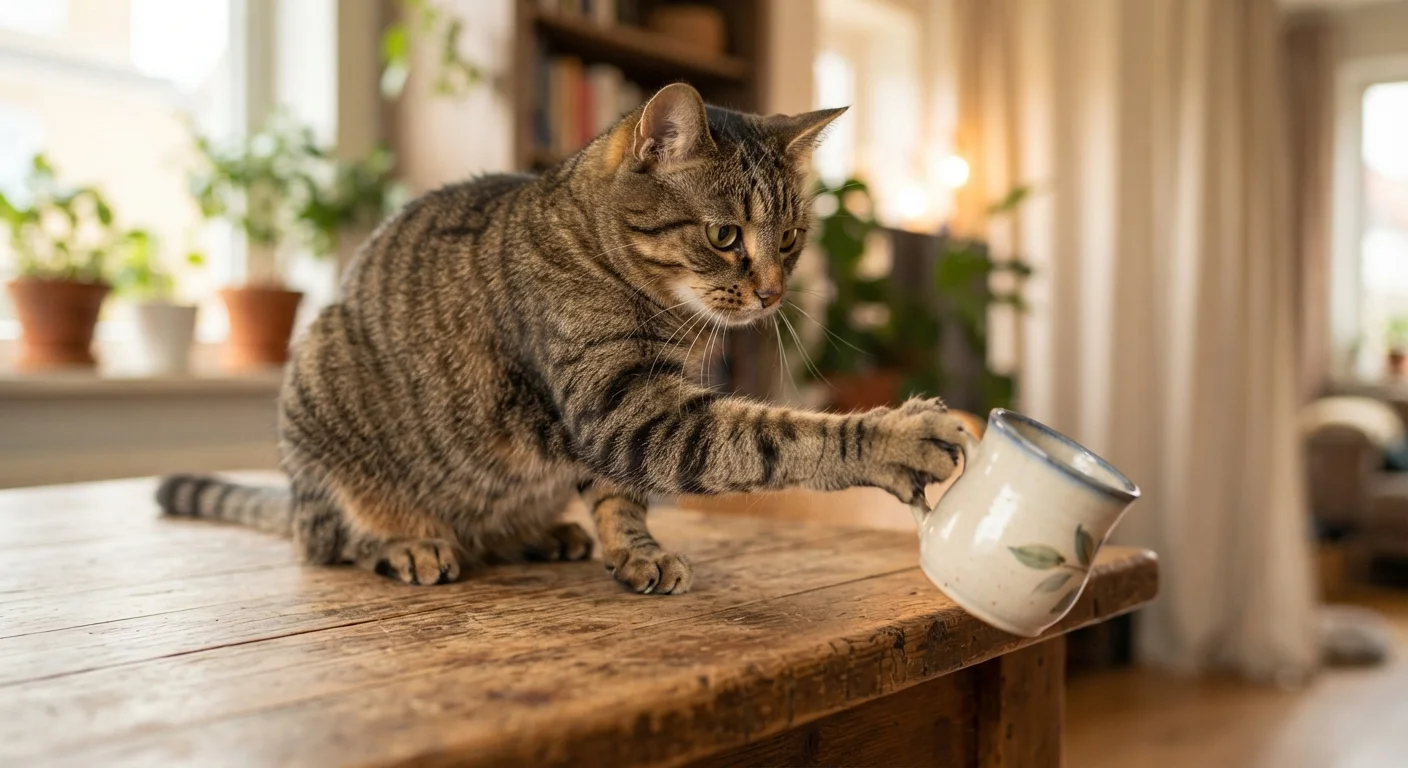
Photo credit: SyndicateExpert.com | Information At The Ready
In this article
That shelf-clearing habit isn't spite. Here's what feline behavior researchers think is really going on.
Key Takeaways
- Cats knock things over out of instinct, curiosity, and boredom — not spite or revenge.
- Predatory instincts drive cats to bat at objects to test if they move, react, or flee.
- Attention-seeking is a real factor: cats learn that knocking things over produces a response from owners.
- Understimulated indoor cats are more likely to redirect energy into object-batting behaviors.
- Environmental enrichment and structured play can significantly reduce the behavior.
- The behavior is rarely a sign of a medical problem, but sudden increases in any repetitive behavior are worth discussing with a vet.
The Predatory Instinct Behind the Paw
Long before cats became indoor companions, they relied on a precise set of hunting behaviors to survive. Even well-fed house cats retain that full motor sequence — stalk, pounce, bat, and grab. When a cat swipes at a pen on your desk, it's running through a version of the same routine it would use to assess a mouse or a beetle.
The paw tap serves a specific purpose: testing whether an object is alive, reactive, or safe to grab. A water bottle that wobbles gets a second tap. A coffee mug that doesn't respond may get nudged off the edge entirely. From the cat's perspective, this is competent, methodical investigation — not chaos.
This instinct is especially active in cats that don't get enough outlet for predatory play. As our related coverage on enrichment cats actually use explains, unmet predatory urges tend to redirect onto whatever is available — including the items on your bookshelf.
Redirect Before You React
When you see your cat preparing to push something off a surface, resist the urge to react loudly — that reaction is often the reward. Instead, redirect attention immediately with a toy or a short play session. Over time, proactive engagement before the behavior starts is more effective than responding after the fact.
The Attention-Seeking Loop Owners Accidentally Create
Here's what many owners don't realize: the first time their cat knocked something over and they jumped up, gasped, or rushed to check the damage, they taught their cat something valuable. A dramatic human reaction is attention, and cats are efficient learners when outcomes are consistent.
Over time, the behavior can shift from pure instinct to a deliberate strategy. A cat that's learned "knocking the remote off the coffee table produces my owner" will return to that method when it wants interaction. The sustained eye contact that often precedes the push is a telltale sign — the cat is watching for your cue.
This doesn't make cats manipulative in any complex sense. It reflects straightforward associative learning. Cats that feel understimulated or under-attended will naturally gravitate toward behaviors that reliably produce results. A calm, non-reactive response — paired with a proactive increase in structured play — tends to reduce frequency over time.
2–3x
More active during crepuscular hours
Cats are crepuscular animals, showing peak activity at dawn and dusk — the times when object-directed behaviors are most commonly reported by owners.
~50%
Indoor cats showing boredom-related behaviors
Various feline welfare surveys suggest roughly half of indoor-only cats exhibit at least one behavior consistent with under-stimulation, including repetitive object manipulation.
5–10 min
Recommended interactive play per session
Feline behavior specialists generally recommend two to three short interactive play sessions per day as a baseline for meeting a cat's predatory behavioral needs.
Boredom, Stimulation, and the Indoor Cat Problem
Indoor cats live safer lives, but the environment is often significantly less stimulating than their behavioral needs require. Without the micro-decisions involved in outdoor exploration — tracking sounds, navigating terrain, encountering unpredictable stimuli — indoor cats can accumulate restless energy that has to go somewhere.
Object batting is one of the more benign outlets. Keeping an indoor cat mentally and physically active requires deliberate effort from owners: rotating toys, providing vertical space, and scheduling interactive play that mimics the arc of a hunt. Cats given consistent outlets for predatory energy tend to show fewer displacement behaviors overall.
It's worth noting that stress can also manifest in behavioral shifts. If you've noticed your cat becoming more erratic or restless alongside the table-clearing, our coverage of recognizing stress signs in cats may be a useful companion read. Changes in environment, routine, or household dynamics are common underlying factors.
What Owners Can Actually Do
The most effective interventions address the underlying driver rather than the surface behavior. If the behavior is instinct-driven, more and better play is the answer — ideally two or three short interactive sessions daily using wand-style toys that replicate prey movement. If it's attention-driven, withdrawing the dramatic reaction and replacing it with scheduled engagement removes the incentive.
For cats that particularly favor high-traffic surfaces, temporarily clearing those areas of tempting objects can interrupt the habit while you work on the root cause. Some owners find that providing a designated "dig and explore" space — a box of crinkle paper, a foraging mat, or a puzzle feeder — gives cats an approved outlet that competes with the table.
A sudden or significant increase in repetitive behaviors is always worth mentioning to a veterinarian, particularly if it's accompanied by changes in appetite, sleep, or grooming. Most of the time, though, the cat knocking things off your shelf is simply doing what cats do — investigating the world one paw tap at a time. The fix is almost always more enrichment, not less tolerance. For a broader look at feline behavior myths, see the truth behind common cat health myths.
Frequently Asked Questions

Author
Pets & Animals Editorial Team
Pets & Animals Editorial Team is the collective byline for our editorial team and contributor network. Articles published under this byline or an editorial pen name are researched, written, and reviewed according to our editorial standards for clarity, consistency, and independence before publication.
View all articles →